Archive | ingredients RSS feed for this section

London Food Festival

12 Sep

On Sunday Cowie and I visited the London Food Festival on behalf of Trusted Places. Walid sent me off with an open brief and a free ticket. It gave me a chance to eat some free food and Cowie a chance to play around with her new and amazing camera…

We got a feel for the scope of the event by checking out their website in advance. Having been to Taste of London in Regent’s Park earlier in the summer were a bit underwhelmed by the line up of chefs and exhibitors. The fact that the website was still advertising for more exhibitors wasn’t the best sign either.

I don’t want this to be negative because it is the event’s first year. They have chosen a great and really accessible venue in the London Business Design Centre in Angel. It’s huge and is frequently home to some very prestigious events. It’s a great space for an event, so long as you fill the room and have plenty of visitors.

We arrived on Sunday morning eager to get stuck in. My immediate concern was that my pre ordered ticket was 15% more expensive than buying one on the day. This is probably a teathing problem and down to the quirks of online ticketing. Still, this was a bit of a luke warm start.

So far, our expectations were fairly low.

A brass band greeted us as we entered the exhibition space. Spurred on by this we spent the next couple of hours exploring the 40 or so exhibitors. Initially the atmosphere was a bit flat due to the lack of visitors. But in a way that is what made this event work. Whereas at the Good Food Show in Earl’s Court there was a constant threat of being crushed, at the London Food Festival you had the space to move freely and the chance to have lengthly conversations with the people on the stands. I remember leaving Earl’s Court with bruises and a sullied view of the world. It was too successful for its own good. This show on the other hand allowed you the intimacy of a Farmers’ Market but on the scale of something much larger.

Tanqueray

Exhibitors ranged from well know brands such as Tanqueray gin, Brown Brothers and Rachel’s Organic to smaller scale, more personal enterprises such as Diablo toasty makers and Royal Berkshire Pork. Most of the stalls were companies I had never heard of. Very few of the big foodie brands had turned up which seemed bad to begin with but actually turned out for the best. It gave me a chance to talk to some really passionate people who love food.

Cha Dao

Peter Green is from the South Coast and loves tea. He and his wife visited somewhere on the continent last year and were amazed by the quality of speciality teas on offer. Inspired by this they brought the concept over to England and set up their own speciality tea company 6 months ago. By the look on Peter’s face he was enjoying every moment of being a tea merchant. His philosophy is simple. He wants people to experiment with tea and try new things. He aims to do this by using clear packaging which shows off the beauty of the tea leaves inside. So often with other tea companies the leaves are hidden by opaque packaging. Not so with Cha Dao. It’s all on show. He is passionate about the art of tea with style. I walked away from Peter’s stand understanding what this show was all about. It’s a great platform for emerging foodie companies to get themselves on the foodie map.

Peter Green

We then met a man demonstating Diablo toastie makers. I’m all for gadgets, but am conscious that they often go unused so was a bit sceptical when watching the demonstartion you can see below. But it was brilliant and looks so cool. It’s great when products are simple, functional and have a personality too. This little gadget is clean, efficient, fun and makes great toasties. You can get them on I want one of those.
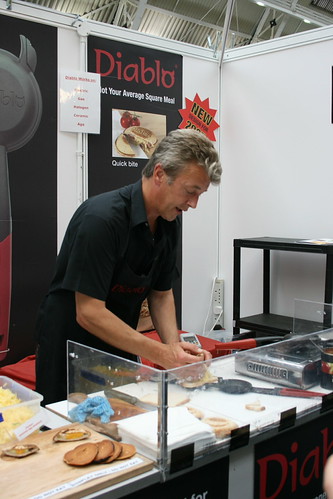
Diablo

We then spent the next half and hour talking to the two charming chaps on the Berghoff cookware stand. They were demonstrating their range of non stick saucepans in such an engaging way that Cowie bought an entire range of non stick pans. They looked fantastic. The ultimate non stick heavy duty pans. Currently they aren’t well know in the UK. They mainly produce white label products that are rebranded by Siemens and Bosch. Good value and heavy duty. But above all, they guys showed the art of good salesmanship. Cowie bought me a new frying pan which I am currently knocking in! Cowie simply couldn’t cope with the twisty removeable handle which could cause a few problems!

Bergh

I was completely duped by the charming Indian stand serving very tasty chicken curries that are about to launch on the UK market. Succulent chicken turned out to my shock to be soya! But it tasted fine and I can imagine them doing very well indeed.

We briefly watched the demonstration by Ready Steady Cook’s James Tanner but lost interest through a combination of not being able to see because of the camera pointing at the wrong thing and a lack of excitement for what he was cooking. We saw Ramsay at the Good Food Show along with Greg Wallace so I couldn’t help but judge them in this bracket. Maybe next year there will be some more interesting demonstrations.
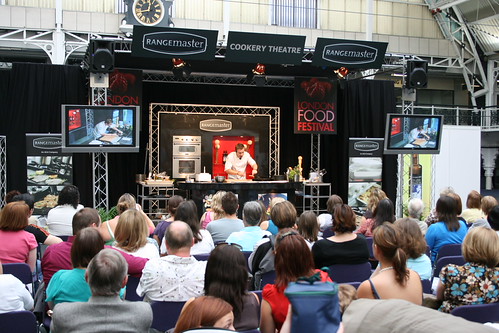
James Tanner

By this point we were starving. So we had a spot of lunch on the balcony. We loved the look of the quiche and palma ham on offer which was lucky because that was the only option! Unfortunately they ran out of palma ham and the quiche despite looking fantastic was really dull. It’s a bit of a shame that a food festival can’t sort out decent catering. On the other hand they did sell Belu water and they do have Dyson Air Blades in the loos. Giles Coren from the Times would love it!

Dyson Air Blade

We finished our lunch and decided against doing a wine tasting given the delicate nature we found ourselves in from the night before. The speaker looked energetic, but it all looked a bit forced from a distance.

Wine Tasting

Once we understood what this show was all about we loved it. Don’t expect big glitzy foodie brands and top of the range celebrity chefs. The London Food Festival is all about up and coming producers and small companies reaching hardcore foodies. It’s a great chance to have a personal chat with them and you get a realy feel for their passion. We’re looking forward to seeing how this evolves next year and will be back for year 2.

Croatian Blackberries

21 Jul

Whilst in Croatia Cowie and I visited the local market at Labin. Perched high up above Rabac the old part of the town is home to a charming market square and a picturesque restaurant clinging to the side of the cliff overlooking the Adriatic.

After searching for ages we eventually found the market- jammed full of fresh Istrian produce. Cafes surround the market serving bracing, black espressos and a flavour of Croatian cafe culture. Young, old, rich, poor, men and women gathered together to just sit in the shade and catch up on a week’s worth of gossip and banter. Cowie and I sat back and breathed it all in. Only the hellish toilets detracted from our experience.

The market itself was on the ground floor with a minstrel’s gallery running around the outside which gives a great vantage point to choose your favourite stall from. It was fascinating watching 2 old women gossiping away with a vast array of multi coloured vegetables in front of them.

What struck us both was how fun the shapes and colours of the produce was. Garlic was both large and small with deep purple veins. Peppers were almost translucent green or deep scarlet with gnarled profile. And the blackberries were phenomenal. Large. Deep purple. Plump. Pristine. We were stunned by them and bought a punnet immediately. They were so sweet and juicy. Quite different from English hedgerow blackberries. Far less tart and gritty. Gorgeous. Reminded me of my GCSE English teacher Mrs Dixon who got us writing essays about Sylvia Plath and Ted Hughes attitudes towards blackberries. Very random! Here’s Sylvia Plath’s pretty dark poem…

Blackberrying

“Nobody in the lane, and nothing, nothing but blackberries,
Blackberries on either side, though on the right mainly,
A blackberry alley, going down in hooks, and a sea
Somewhere at the end of it, heaving. Blackberries
Big as the ball of my thumb, and dumb as eyes
Ebon in the hedges, fat
With blue-red juices. These they squander on my fingers.
I had not asked for such a blood sisterhood; they must love me.
They accommodate themselves to my milkbottle, flattening their sides.

Overhead go the choughs in black, cacophonous flocks —
Bits of burnt paper wheeling in a blown sky.
Theirs is the only voice, protesting, protesting.
I do not think the sea will appear at all.
The high, green meadows are glowing, as if lit from within.
I come to one bush of berries so ripe it is a bush of flies,
Hanging their bluegreen bellies and their wing panes in a Chinese screen.
The honey-feast of the berries has stunned them; they believe in heaven.
One more hook, and the berries and bushes end.

The only thing to come now is the sea.
From between two hills a sudden wind funnels at me,
Slapping its phantom laundry in my face.
These hills are too green and sweet to have tasted salt.
I follow the sheep path between them. A last hook brings me
To the hills’ northern face, and the face is orange rock
That looks out on nothing, nothing but a great space
Of white and pewter lights, and a din like silversmiths
Beating and beating at an intractable metal.”

Sylvia Plath

I’m glad to report that our blackberrying experience was less bleak – probably something to do with not getting prickled by thorns and because it was 34’c in Croatia in July and not raining in September in England!

Behind a big strong door was the fish market. Far cooler than the fruit and veg section the catch was spread out over marble tables with langoustine everywhere! In Croatia they call them Scampi which does them no credit whatsoever… there’s been loads of articles in the paper recently about how we export 90% of Britsh laungoustine to the continent and only eat them ourselves in bad pubs with a breadcrumb coating and chips!

Our best meal in Croatia was at Villa Annette where Cowie had langoustine spaghetti with truffles and I had black ravioli with langoustines. Both were stunning and if you happen to be in Istria you simple have to pay them a visit.

We had an amazing culinary time in Croatia feasting on truffles, pasta, fresh fish and gorgeous zesty white wine. Risottos were stunning and pasta was perfect. Better than Italy in many ways!

Perfect Scrambled Eggs?

1 Jul

This is simple. Really simple. But it’s so often done wrong. If anyone ever puts milk in scrambled eggs refuse to eat them. Milk does not belong any where near properly made scrambled eggs. I can just about countenance pouring a slurp of cream into the mix if you’re going to include some smoked salmon… but otherwise there is no need to tamper with what is a very simple piece of alchemy.

Take your best pan out of the cupboard. I enjoy using a seriously heavy Le Crueset sauce pan because it holds the heat so well and has never burnt the goodies inside it. It transfers the heat so well that you only need to use a gentle flame and you will be rewarded with exceptional scrambled eggs.

Take some unsalted butter and melt it gently with a little dash of mustard. Don’t let it burn and try not to use salted butter.

Next whisk up your super fresh eggs. 3 per person normally does the trick.

Then pour into your melted butter and mustard mixture and stir with a wooden spoon. Add some freshly ground black pepper and stir occasionally whilst cooking over a low heat. It’s important not to let the pan get too hot otherwise the eggs might catch the pan and you won’t be eating gloriously smooth scrambled eggs. It’ll be more like a badly made ommlette.

Don’t add salt to the eggs whilst they are cooking as I find this causes the eggs to behave very strangely. Salt breaks down the eggy proteins in such a way as to change their state quite dramatically. Only add the salt to your eggs once they are cooked.

In my other pan I melted some butter and added some chopped mushrooms. I fried these slowly and added plenty of good salt and pepper as they cooked before adding some baby plum tomatoes half way through. Simply adding some thyme and a dash of olive oil was enough to make them taste delicious!

Plate it all up on some spelt bread and add some parsley, salt and pepper to the eggs. I like my eggs a little bit runny. It’s often best to under cook them and then just set to one side as they will cook in their own heat.

How do you eat yours?

Lego Salt and Pepper Shaker

30 Jun

I am in love with my Lego Salt and Pepper Shakers even though both are pretty much unusable from a cooking point of view! Especially if you are using proper salt and pepper.

They are guaranteed to cause a stir.

Salt

30 Jun

I used to use Malden Sea Salt which is great but then I found Noirmoutier Fleur de Sel. It looks a bit like crushed, crystally marble. It’s almost sharp to the touch but sprinkles on food like snow and I love it!

Wikipedia says Fleur de Sel is best used like a herb; simply sprinkled on food just before serving.

“Fleur de sel (“Flower of salt” in French) is a hand-harvested sea salt collected by workers who scrape only the top layer of salt before it sinks to the bottom of large salt pans. Traditional French fleur de sel is collected off the coast of Brittany & Noirmoutier, and is slightly grey due to the sandy minerals collected in the process of harvesting the salt from the pans. It is also produced in Camargue.

Also known in Portuguese as “flor de sal”, the hand-harvested variant from the Algarve region of Portugal is becoming known, as it is of similar quality to the French fleur de sel or better. In addition, it has the advantage of being pure white and usually sells for half the price of the french fleur de sel.

Fleur de sel is best used similarly to fresh herbs, sprinkling it onto food just before serving.”

Pepper

30 Jun

Good pepper makes such a difference. It’s nose-tingling, lively, feisty and the making of many a meal.

A quick look at Wikipedia reveals all:

“Black pepper (Piper nigrum) is a flowering vine in the family Piperaceae, cultivated for its fruit, which is usually dried and used as a spice and seasoning. The same fruit is also used to produce white pepper and green pepper. Black pepper is native to South India and is extensively cultivated there and elsewhere in tropical regions. The fruit, known as a peppercorn when dried, is a small drupe five millimetres in diameter, dark red when fully mature, containing a single seed.

Dried ground pepper is one of the most common spices in European cuisine and its descendants, having been known and prized since antiquity for both its flavour and its use as a medicine. The spiciness of black pepper is due to the chemical piperine. Ground black peppercorn, usually referred to simply as “pepper”, may be found on nearly every dinner table in some parts of the world, often alongside table salt.

The word “pepper” is derived from the Sanskrit pippali, the word for long pepper via the Latin piper which was by the Romans to refer both to pepper and long pepper, as the Romans erroneously believed that both of these spices were derived from the same plant. The English word for pepper is derived from the Old English pipor. The Latin word is also the source of German pfeffer, French poivre, Dutch peper, and other similar forms. In the 16th century, pepper started referring to the unrelated New World chile peppers as well. “Pepper” was used in a figurative sense to mean “spirit” or “energy” at least as far back as the 1840s; in the early 20th century, this was shortened to pep.

Pepper gets its spicy heat mostly from the piperine compound, which is found both in the outer fruit and in the seed. Refined piperine, milligram-for-milligram, is about one per cent as hot as the capsaicin in chile peppers. The outer fruit layer, left on black pepper, also contains important odour-contributing terpenes including pinene, sabinene, limonene, caryophyllene, and linalool, which give citrusy, woody, and floral notes. These scents are mostly missing in white pepper, which is stripped of the fruit layer. White pepper can gain some different odours (including musty notes) from its longer fermentation stage.

Pepper loses flavour and aroma through evaporation, so airtight storage helps preserve pepper’s original spiciness longer. Pepper can also lose flavour when exposed to light, which can transform piperine into nearly tasteless isochavicine. Once ground, pepper’s aromatics can evaporate quickly; most culinary sources recommend grinding whole peppercorns immediately before use for this reason.”

So pepper is a fruit! Never knew that.

Here’s the pepper I’ve been using recently. I bought it from the pepper man at Borough market…

It’s called Tellicherry Garbled Extra Special Bold and is superb. I love the way all the pepper corns look like mini footballs. Just don’t spill it all over the floor!

With such good pepper, it would be sacrilege to use a crappy pepper grinder… so I invested in my pride and joy… my baseball bat pepper grinder.

Tomato Pasta

30 Jun

Hardly original but incredibly tasty and very satisfying to make. I was made in Italy and so was this recipe. Having not been food shopping since visiting Borough Market last week I was forced to delve inside our empty fridge and erratically stocked cupboards.

I had a bag of large bag of baby tomatoes bought from a very nice man at Borough Market, some smoked garlic from the garlic specialists on the Isle of White and some old red wine. So I cooked the tomatoes down into rich red goo and threw in a generous amount of sticky, sweet, smoked garlic. This all simmered away getting sweeter and more unctuous by the second. A good sprinkling of fleur de mer sea salt, some chili, tomato paste, chopped tomatoes from a tin and some red wine were added half way through to help pad it out and add some spice.

Just before serving it I grabbed some basil and thyme from my herb pot that’s doing very well in this rainy June weather and served it up. The pasta only boiled for 6 minutes so it still had a bit of bite. I stirred it all together in the pan to make sure all the pasta was coated in the sauce and then tucked in.

It was so satisfying cooking this delicious dish from scratch and only having a handful of ingredients to work with apart from some amazing tomatoes! Next time I’ll make my own pasta too. I just need some more 00 flour. It’s great to have the time to cook properly. It makes life so much better.